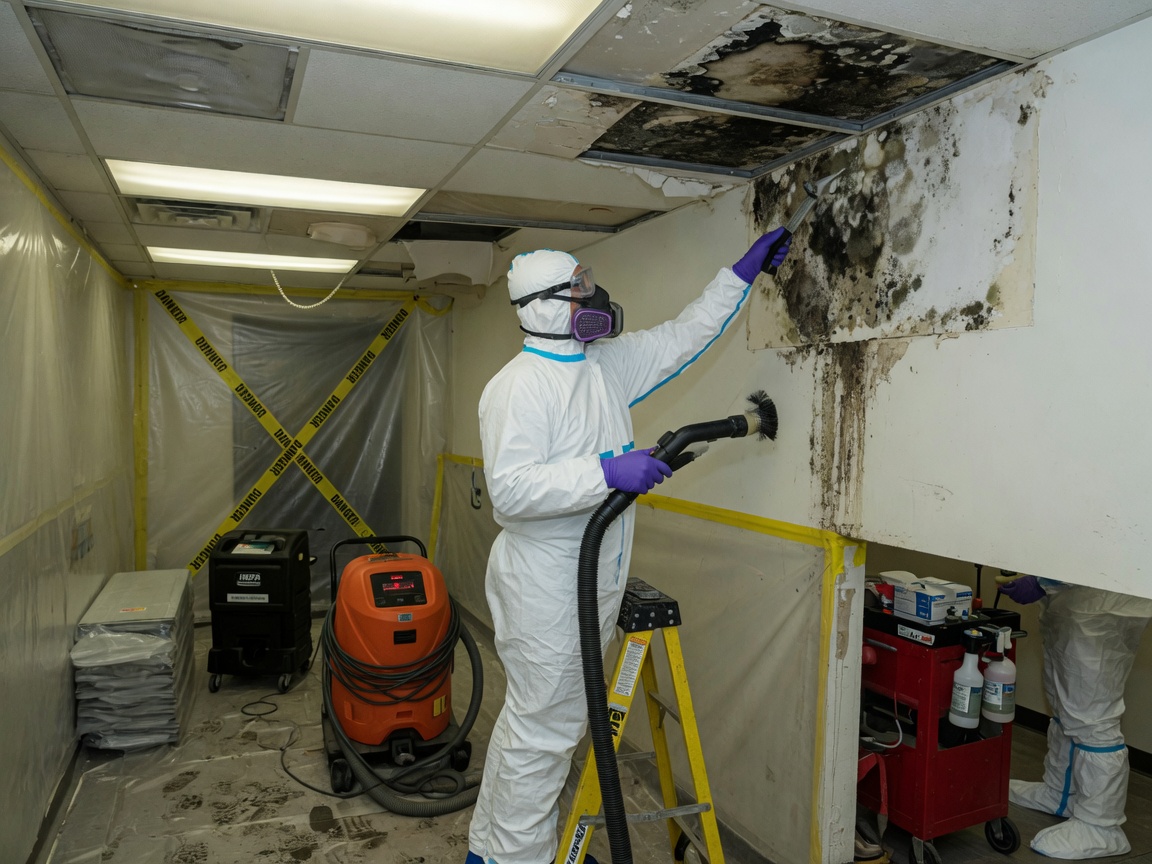
Carrollton commercial properties in neighborhoods like North Carrollton and Old Town Carrollton often sit on older slabs with limited ventilation, allowing hidden mold to develop behind walls after severe storms roll through Dallas County. Hot, humid summers keep indoor moisture levels elevated, especially in buildings near Josey Ranch Lake where groundwater seepage adds to the load. Technicians must account for HVAC systems that recirculate spores across large floor plates and use negative air machines plus HEPA filtration to prevent cross-contamination into adjacent tenant spaces.
Mold growth in Trinity Mills and Indian Creek commercial sites frequently follows roof leaks or pipe bursts that saturate ceiling tiles and insulation. These materials hold moisture longer than drywall, creating pockets that standard drying fans miss. Remediation crews remove affected sections in sections, apply EPA-registered antimicrobials rated for porous substrates, and document moisture readings with thermal imaging to satisfy Dallas building inspectors before re-occupancy. Failure to address the source water path usually leads to rapid recurrence within weeks.
Edge cases appear in Downtown Carrollton retail spaces where shared walls with neighboring businesses complicate containment. Crews install temporary barriers that meet fire-code requirements while still allowing customer access to unaffected areas. Post-remediation air sampling confirms spore counts drop below outdoor baselines before clearance letters are issued, a step required by many Carrollton commercial leases.
Technician insight
In Carrollton, the thing that catches most people out with Commercial Mold Remediation is how quickly humidity from hot summers re-wets drywall in older buildings along Trinity Mills Road after a single storm; crews often find the original leak dried but new colonies forming behind shared walls because the slab never fully released its moisture.
Mold Behind Retail Walls After June Storm
A clothing store in Trinity Mills reported musty odors two weeks after heavy rain. Inspection revealed water had wicked up from the slab into base drywall and insulation. Crews isolated the sales floor, removed 120 linear feet of affected material, treated the framing, and dried the space for five days. Air tests cleared the space and the business reopened without further odor complaints.
Commercial Mold Remediation Services We Offer
✓HVAC Mold Remediation
Clean and sanitize commercial ductwork and coils after water intrusion to stop spore distribution through the building's air system.
✓Commercial Drywall Mold Removal
Cut out and replace mold-affected drywall in offices and retail spaces while maintaining negative pressure to protect adjacent suites.
✓Ceiling Tile and Insulation Replacement
Remove saturated acoustic tiles and insulation common in Trinity Mills warehouses and replace with mold-resistant materials.
✓Post-Storm Commercial Drying
Deploy industrial dehumidifiers and air movers to bring humidity below 50 percent after Dallas County thunderstorms before mold colonies expand.
✓Flooring Mold Extraction
Lift and treat carpet, vinyl, or hardwood in high-traffic commercial areas where standing water from leaks promotes subsurface growth.
Commercial Mold Remediation Cost in Carrollton, TX
| Service | Typical Range | What Affects It |
|---|---|---|
| Small retail suite remediation | $2,800–$5,500 | Depends on square footage and depth of hidden growth behind walls. |
| Office HVAC and duct cleaning | $1,900–$4,200 | Varies with number of zones and coil condition after storm flooding. |
| Warehouse insulation and ceiling work | $4,500–$9,000 | Higher when multiple bays are affected and access requires lifts. |
Ranges are typical for Carrollton, TX and confirmed with an exact written quote before any work starts.
How it works
- 1
Site Assessment
Inspect all affected zones in the Carrollton commercial property using moisture meters and borescopes to map hidden growth.
- 2
Containment Setup
Erect plastic barriers and run negative air machines to isolate the work area from the rest of the building.
- 3
Material Removal
Safely extract moldy drywall, insulation, and ceiling materials and bag them for disposal per local regulations.
- 4
Antimicrobial Treatment And Drying
Apply EPA-registered products to remaining surfaces and run commercial drying equipment until moisture levels stabilize.
- 5
Clearance Testing
Perform air and surface sampling to confirm mold counts meet post-remediation standards before reopening.
Pricing
Scope-based pricing after on-site inspection; larger square footage and hidden growth increase cost.